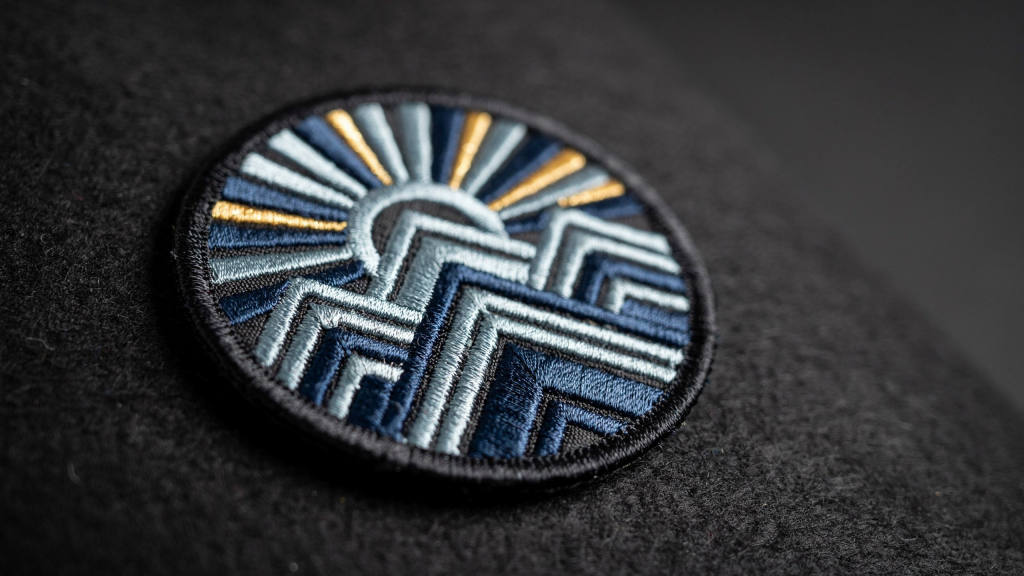
Shaders patches use light and thread direction to create a 3D effect that changes as you walk. It is the closest thing to holography in the textile world. Shaders embroidery uses directional stitching a technique that varies stitch angle, weight, and density across a single design to control how light reflects off the thread surface and simulate depth, shadow, and movement.
A standard embroidered patch looks the same from every angle. A custom shaders patch reads differently in morning light versus afternoon sun, from straight on versus side angle, from close range versus across a room.
This guide breaks down exactly how shaders embroidery works, why it produces results that no other patch technology replicates, and how Custom Patches Australia delivers the technique at production scale.
Thread Direction: The Secret to “Moving” Graphics
Light hits thread at different angles. By varying the stitch inclination, we control how the sun reflects off your logo. This creates a shimmering effect that looks like real-time shading.
Standard embroidery runs all stitches in the same direction across a fill area. Every thread row reflects light identically. The result is a flat, consistent surface with no internal contrast, visually clean but dimensionally dead.
The core principle is simple physics. A thread row running at 0 degrees horizontal reflects light directly back to a viewer standing in front of the patch. The same thread row rotated to 45 degrees deflects that light away from the viewer.
Stitch angle variables used in shaders embroidery:
0-degree horizontal fill produces maximum light return to a front-facing viewer. Used for highlight areas, the brightest zones in a shaded design that simulate direct light hitting a raised surface.
45-degree cross-hatching stitches running diagonally across a fill area,produces a mid-tone reflection value. Cross-hatching at 45 degrees creates a texture that the eye reads as a transitional zone between highlight and shadow.
90-degree vertical fill deflects light at the maximum angle from a front-facing viewer, producing the darkest apparent value.
Radial stitching thread rows that fan outward from a central point produces a dimensional convex effect. A circular logo element stitched radially appears to dome outward from the patch surface because the stitch angles shift continuously around the circumference, creating a light-reflection gradient that the eye interprets as three-dimensional curvature.
Texture Overlap: Creating Depth Without the Bulk
Standard 3D foam is bulky and catches on gear. Shaders patches create depth by layering different thread weights. You get the 3D look with a slim, professional profile.
Thread weight explained:
Thread weight is a measurement of thread thickness using a standardised numbering system. The number refers to the length of thread per unit of weight, a higher number means finer thread, a lower number means thicker thread.
- 40-weight thread is the standard fill thread for most embroidery production. It produces a solid, visible stitch that covers backing fabric efficiently and holds colour saturation well.
- 60-weight thread is significantly finer than 40-weight. It produces a denser, smoother stitch surface with less individual thread visibility. In shaders embroidery, 60-weight thread handles transition zones and fine detail areas where a smooth surface reads as a highlight or a polished surface finish.
- Layering the two weights within a single design creates genuine tactile texture variation that reinforces the visual shading effect. A zone stitched with coarser 40-weight thread catches more light and appears slightly raised relative to an adjacent zone in 60-weight fine thread because it physically is slightly raised by the accumulated thread height.
Troubleshooting: When Shaders Don’t Work
Not every design translates to shaders embroidery. The technique has specific requirements and specific failure modes. Identifying them at the brief stage prevents expensive production errors.
Small text below 6mm height fails in shaders. Shaders embroidery requires space to execute stitch angle transitions. Text below 6mm character height does not provide enough stitch rows to vary angles meaningfully.
The character fills with a single stitch direction and the shading effect disappears entirely. The text also risks legibility failure at small sizes when thread-weight variation and angle changes disrupt the clean stroke edges that make letterforms readable.
High-contrast hard edges fight the gradient effect. Shaders embroidery creates value transitions through stitch angle and thread weight. A design with sharp, high-contrast outlines between colour zones a black border around a white fill, for example undercuts the gradient read by giving the eye a definitive boundary that overrides the soft shading transition.
Overly complex artwork exceeds stitch map resolution. A design with 15 distinct colour zones and multiple gradient transitions produces a stitch map of extreme complexity. Embroidery machine execution of complex maps introduces small registration errors between colour zones.
Dark garments reduce shading visibility. Shaders effects rely on contrast between highlight and shadow thread angles. On a white or light garment, the luminosity difference between a 0-degree highlight zone and a 90-degree shadow zone reads clearly. On a black garment, both zones appear dark and the shading differential collapses.
Circular and radial designs lose shading on curved garment surfaces. A radial stitch map calibrated for flat surface light reflection produces different results on the curved surface of a cap or a sleeve. The garment curvature introduces its own light reflection variable that interacts with the stitch angle map.
FAQ
How much do shaders patches cost compared to standard embroidery?
Shaders patches carry a premium over standard fill-stitch embroidery due to the specialist digitising time and increased machine stitch count. Per-unit production cost runs 20% to 40% above standard embroidery at equivalent sizes. Bulk orders reduce the per-unit premium significantly as the digitising cost amortises across the full run.
Are shaders patches durable?
Yes. The durability of a shaders patch equals standard embroidery at equivalent thread quality and backing specification. The shading effect comes from stitch angle and thread weight variation, structural properties of the embroidery that do not degrade through washing or wear.
Can I use shaders on a Velcro backing?
Yes. Shaders embroidery applies to any patch backing type. Velcro loop, iron-on, sew-on, or magnetic. The backing choice is independent of the embroidery technique on the patch face.
Level Up Your Brand with Custom Patches Australia
Standard patches put a logo on a garment. A custom shaders patch puts a light-reactive, dimensionally engineered visual object on a garment, one that changes as the wearer moves and holds attention in a way that flat embroidery never reaches.
Custom Patches Australia handles the full shaders production process locally. From artwork audit through digitising consultation, sample production, and bulk fulfilment. The first step is getting the artwork in front of the Melbourne digitising team for a shader-readiness assessment. That review identifies which design elements translate directly to shaders treatment, which need adjustment, and what the stitch map will look like before a single thread goes through the machine.