
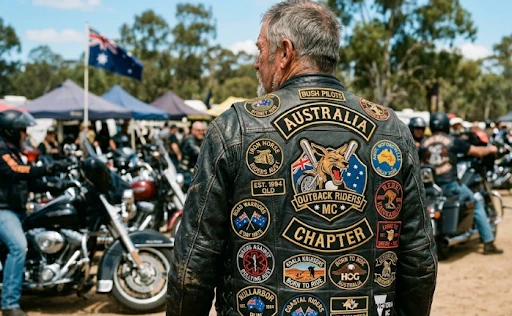
Few items of clothing carry as much history, hierarchy and hidden meaning as motorcycle club patches. To a casual observer, a leather or denim vest covered in embroidered emblems might look like decoration.
To anyone who understands the culture, every patch is a sentence, and every placement tells a story about who the rider is, what they have earned, and where they belong.
From the iconic three piece back patch to the smaller symbols pinned near the collar, motorcycle club patches form a coded language that has been read and respected by riders for more than seventy five years.
In this guide, we unpack motorcycle club patch meanings from the ground up, covering the classic three piece patch system, the most common biker symbols on the road today, and a detailed look at Hells Angels patches meaning, arguably the most recognised set of biker patch meanings in the world.
Whether you are researching the culture out of curiosity, restoring a vintage vest, or ready to design something original for your own riding club, this article will give you a clear, accurate picture of how motorcycle vest patches work.
Start Designing Your Own Club Identity Today
Understanding the meaning of the custom motorcycle patches is the first step. The next is putting that knowledge into a design that represents your own club, crew or brand. Our team at Custom Patches Australia works with riding clubs, motorcycle dealerships and individual collectors across the country.
We produce original, high quality embroidered motorcycle patches from concept through to delivery. Start your custom patch design and speak with our patch specialist about your project.
The Rich History and Culture Behind Motorcycle Club Patches
The tradition of wearing large embroidered patches on a leather or denim vest, known in club culture as a “cut”, grew out of returning World War Two servicemen who missed the structure, brotherhood and identity of military life.
Many of these riders had grown accustomed to squadron insignia and unit patches during their service, and that visual language carried over naturally into the motorcycle clubs that began forming across the United States in the late 1940s.
Early clubs used patches to signal membership, rank and territory long before formal trademarks or club constitutions existed. Over the following decades, as motorcycle clubs organised into more structured chapters, the patch system became increasingly standardised.
Today, motorcycle club symbols follow recognisable conventions across most clubs, even though each organisation designs its own unique artwork, colours and wording. Understanding this history matters because it explains why patches are treated with such seriousness inside club culture.
A patch is rarely just a design choice. It usually represents a period of proving loyalty, a rank earned through years of commitment, or a geographic claim that the club actively defends.
This is very different from the way patches are used in mainstream fashion, sport or corporate branding, where a logo can be applied or removed with no consequence at all.
The Three Piece Patch System Explained
The most recognisable structure in biker patch meanings is the three piece back patch, sometimes called a full set or simply “colours”. This format is used by the vast majority of established motorcycle clubs, including well known outlaw clubs and mainstream riding associations alike.
Top Rocker
The top rocker is the curved patch positioned at the very top of the back, directly below the collar. It almost always displays the club name in large embroidered lettering. This is the first element anyone reads when they see a member from a distance, and it is the clearest identifier of which organisation a rider belongs to.
Centre Patch
Sitting below the top rocker is the centre patch, which carries the club’s main emblem or logo. This is the most visually detailed piece of the set and the one clubs guard most closely, since it functions as the organisation’s core identity. Centre patch designs vary enormously between clubs, drawing on everything from military insignia and mythology to regional symbols and folklore.
Bottom Rocker
The bottom rocker curves beneath the centre patch and typically states a state, city or region. This piece represents a territorial claim, showing which area the chapter operates in. Because territory can be a sensitive topic between clubs, the bottom rocker is often considered the most contested element of the entire back patch.
The MC Patch
Many clubs also wear a small square or diamond shaped patch reading “MC”, short for Motorcycle Club. This patch confirms that the group operates as a structured motorcycle club rather than a casual riding association, and it is usually positioned near the centre patch to complete the full back set.
Together, these pieces form what riders call “flying full colours”. Earning the right to wear a complete three piece set is not automatic. New members typically begin as a hang around, move into a prospect period that can last a year or more, and only receive the full patch set once the chapter votes to formally accept them.
Common Motorcycle Club Symbols and Biker Patch Meanings
Beyond the back patch, riders wear a wide range of smaller symbols on the front of a vest, on the chest, or along the edges. Recognising these motorcycle club symbols helps explain a huge amount about the person wearing them.
The 1% Diamond Patch
Perhaps the most talked about biker patch meanings belongs to the small diamond shaped patch reading “1%”. This symbol is generally traced back to a comment attributed to the American Motorcyclist Association following a rowdy 1947 rally, suggesting that the overwhelming majority of motorcyclists were law abiding citizens while a small percentage operated outside those norms.
Certain clubs adopted the 1% diamond as a badge that intentionally sets them apart from mainstream motorcycling associations. It is important to note this patch is not a specific club emblem, but a broader category claim worn by multiple organisations.
Rank and Officer Patches
Many clubs use small rectangular patches to indicate a member’s role within the chapter, such as President, Vice President, Sergeant at Arms, Road Captain or Treasurer. These patches are usually worn on the front of the vest and give other riders an instant read on the chapter’s leadership structure.
Nomad Patches
Some clubs run a nomad chapter, made up of members who are not tied to a specific city or region. Instead of a location, the bottom rocker on a nomad patch simply reads “Nomads”. This designation is common across several long running motorcycle organisations and signals a member who operates more broadly across a wider territory.
Skulls, Wings and Mythological Imagery
Centre patch artwork frequently draws on skulls, wings, flames and mythological figures, chosen to project strength, rebellion and a sense of danger. Each club’s specific design is treated as intellectual property within the culture, defended fiercely, and never used casually by outsiders.
Hells Angels Patches Meaning: History’s Most Recognised Biker Symbols
No discussion of motorcycle club patch meanings would be complete without covering the Hells Angels, whose patches are arguably the most recognised set of Hells Angels symbols in global popular culture. The club was formed in California in 1948, and its patch system has become a template that much of the wider biker world still references today.
The Death Head Centre Patch
The centrepiece of the Hells Angels back patch is a winged skull design known within the club as the Death Head. The imagery is widely understood to draw on military squadron insignia from the World War Two era, and it has remained the club’s core visual identity for over seven decades. In 1966, the organisation formally trademarked the Death Head design along with the Hells Angels name, giving it legal protection that the club actively enforces around the world.
Top and Bottom Rockers
Following the standard three piece format, the top rocker displays “Hells Angels” in red lettering on a white background, while the bottom rocker names the specific chapter’s territory, such as a state or city. A small “MC” patch typically completes the set, confirming the organisation’s status as a motorcycle club.
The 81 Numeric Code
One of the more distinctive Hells Angels symbols is the number 81. Using a simple substitution, H is the eighth letter of the alphabet and A is the first, giving the numeric shorthand “81” for Hells Angels. This code appears on clothing, accessories and support merchandise worn by friends and associates of the club who are not full patched members, allowing a level of public affiliation without displaying the protected Death Head emblem itself.
A Protected and Regulated Symbol
Because the Death Head and the Hells Angels name are legally trademarked, their use is tightly controlled, and wearing a full replica set without having earned it through the club is treated extremely seriously within that culture.
This is worth understanding for anyone researching Hells Angels patches meaning out of general interest, as it explains why these particular designs are protected rather than freely available for casual or commercial reproduction, unlike original club patches created for personal or independent riding groups.
Elevate Your Vest with a Genuinely Original Design
If the history of the Death Head and the three piece patch system has inspired you to build something for your own club, now is the time to move from research to design. Ordering patches in Australia is easier than ever.
We help independent riding clubs and individual riders create original embroidered motorcycle patches that reflect their own identity, values and territory, rather than copying protected club property. Speak to our design team about turning your concept into a wearable patch.
Biker Vest Patches and Motorcycle Vest Patches: Placement and Etiquette
Placement matters as much as design when it comes to motorcycle vest patches. The back of the vest is reserved for the primary three piece set among club members, while the front panels typically carry smaller patches such as a name tag, rank designation, years of service pins, or memorial patches for fallen members.
The upper chest area is often used for a club’s MC patch or state flag, while smaller novelty and event patches tend to sit lower on the vest or along the edges. Etiquette around biker vest patches is taken seriously in club culture. Wearing a patch that has not been earned, placing a patch incorrectly, or displaying another club’s colours without permission can all cause serious offence.
Riders outside formal clubs generally have far more freedom, using their vest to display personal interests, ride history, charity events or custom artwork rather than a structured rank system.
From Club Tradition to Custom Creation: Embroidered Motorcycle Patches Today
While the three piece system remains closely associated with formal motorcycle clubs, the broader appeal of embroidered motorcycle patches has grown well beyond that culture.
Riding groups, motorcycle dealerships, touring communities and individual collectors now commission custom biker patches to mark road trips, celebrate a particular bike model, promote a local riding event, or simply express personal style on a jacket or vest.
Modern embroidery techniques make it possible to recreate fine detail, shading and dimension that were far harder to achieve decades ago, giving today’s custom motorcycle patches a level of depth that rivals traditional club artwork.
Options such as merrowed borders, metallic thread, and PVC patches or leather designs allow riders to choose a finish that suits both the design and the way the patch will be worn or displayed.
Why Choose Custom Patches Australia for Custom Motorcycle Patches
Plenty of overseas patch manufacturers can produce a basic design, but working with a supplier who understands both embroidery craftsmanship and the cultural weight behind motorcycle club symbols makes a real difference to the finished product.
Custom Patches Australia, one of the top 15 best patch companies in Australia offers a few clear advantages for riders and clubs designing their own patches.
- Local design consultation with specialists who understand Australian riding culture, club conventions and vest etiquette
- A wide range of finishes, including traditional embroidery, merrowed and hot cut borders, PVC, leather and chenille options
- No minimum order barriers that shut out individual riders, alongside bulk pricing for chapters ordering full sets
- Fast turnaround and clear proofing at every stage, so your design is approved before production begins
- A commitment to original artwork, helping clubs build their own distinct identity rather than imitating protected designs like the Hells Angels Death Head
Compared to generic overseas patch mills that mass produce templated designs, our process is built around getting the fine detail right, from accurate colour matching to correctly proportioned rockers and centre patches, so the finished product looks the way it does in your imagination.
Frequently Asked Questions
What do the patches on a motorcycle club vest mean?
Motorcycle club patches signify identity, rank, and territory, comprising a three-piece set: top rocker (club name), center patch (emblem), and bottom rocker (chapter). Additional patches indicate roles and membership.
What is the meaning of the 1% patch on a biker vest?
The 1% diamond patch signifies law-abiding motorcyclists distinguishing themselves from the 1% engaging in outlaw behavior, adopted by various motorcycle clubs as a badge.
Can anyone wear Hells Angels patches?
No. The Hells Angels trademark their designs since 1966, strictly controlling use. Unauthorized wear can lead to serious consequences, unlike custom patches for independent riders.
How long does it take to design and produce a custom motorcycle patch?
Custom embroidered motorcycle patches typically take a few weeks from concept to completion, with bulk orders taking longer due to complexity.
Ride with a Patch That Tells Your Story
Motorcycle club patches carry far more meaning than most people realise, from the rank system built into the three piece back set to the trademarked history behind the Hells Angels Death Head.
Understanding motorcycle club patch meanings gives you a genuine appreciation for a culture built on loyalty, hierarchy and hard earned recognition, whether you are researching biker patch meanings out of curiosity or planning a design for your own riding group.
If that research has left you ready to create something original, our team at Custom Patches Australia can help you design custom biker patches and embroidered motorcycle patches that represent exactly who you are on the road. Get started with a free design consultation by contacting us and turn your concept into a patch worth wearing.