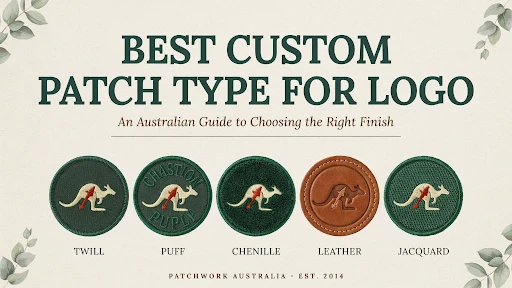
A screen can show hairline strokes and tiny lettering that a physical patch cannot reproduce at the same scale. The best custom patch type for logo depends on what the artwork must preserve.
For Australian businesses, clubs and apparel brands, choosing custom logo patches Australia starts with four facts: logo detail, finished patch size, garment placement and exposure. Those factors usually identify the right production method quickly.
Start With the Logo, Then Choose the Patch Material
The best custom patch type for logo becomes easier to identify when artwork is viewed at finished size. A 75 mm badge gives fine elements much less room than an A4 logo proof.
This matters for custom patches for business logos because digital artwork has no thread thickness, mould depth or fabric edge. Physical production introduces limits that should be resolved before a bulk order is approved.
A useful first pass is simple: inspect the smallest text, thinnest line, number of colours, gradients, open spaces and overall silhouette. Then decide what visual qualities must survive unchanged.
|
Logo requirement |
Strong starting choice |
Reason |
| Bold shapes and clear lettering | Embroidered | Raised thread gives strong texture and presence |
| Fine text and thin linework | Woven | Finer threads retain small detail |
| Rain, mud and outdoor use | PVC | Moulded construction handles demanding environments |
| Gradients or photo-style artwork | Sublimated | Printed colour handles tonal changes cleanly |
| Premium, understated branding | Leather | Engraved or debossed finishes suit restrained marks |
| Large varsity letters or mascots | Chenille | Thick yarn gives bold, oversized texture |
These materials sit within the wider range of custom patch types used for Australian uniforms, apparel and branded merchandise. The logo itself should decide which material deserves closer consideration.
Embroidery Suits Bold Logos That Need Texture
For a clean emblem, block wordmark or club crest, the best custom patch type for logo is often embroidery. Raised stitching adds visible depth and sits naturally on jackets, caps, uniforms and heavier apparel.
The current range of custom embroidered patches includes standard stitching, satin stitch, metallic thread and dimensional options. Embroidered logo patches Australia work best when letters and internal gaps remain large enough to stitch clearly.
Check the Smallest Element Before Approving Embroidery
Embroidery can reproduce considerable detail after good digitising, yet physical thread still occupies space. Tiny counters inside letters, hairline strokes and tightly packed wording can close up when the design is reduced.
Scale changes the production outcome. A detailed mark can work at jacket-back size and become crowded on a small chest patch. Check the artwork at final dimensions before approving it.
Simple Logo Example
Picture a plumbing company mark with a bold droplet, two solid colours and a short company name underneath. Embroidery can preserve the shapes, add texture and remain readable from normal viewing distance.
Detailed Logo Example
Now picture a café crest containing curved micro-text, a thin illustrated branch and a founding date. A woven construction usually gives those elements more room to remain separate and recognisable.
Woven Patches Give Fine Logos More Resolution
When comparing embroidered vs woven patches for logos, examine detail before texture. The best custom patch type for logo with small lettering, thin outlines or compact crest elements is commonly a woven patch.
Custom woven patches use finer threads and sit flatter than standard embroidery. That makes woven logo patches Australia especially useful for brand marks that must stay clear on smaller uniform, cap or merchandise placements.
For buyers searching for the best patch for detailed logo, ask whether removing a tagline or thickening a line changes the brand mark. Woven production can reduce the need for those edits.
PVC Makes Sense When the Logo Works Outdoors
The best custom patch type for logo used on outdoor gear may be PVC when rain, mud or repeated handling are expected. Moulded construction also supports defined colour blocks and raised 2D or 3D effects.
Custom PVC patches are used across uniforms, bags, tactical gear and outdoor applications. PVC logo patches Australia suit logos with strong shapes that need a durable, wipe-clean surface and a contemporary finish.
PVC still needs artwork discipline. Very fine gradients and photo-like shading belong to a different process. Intricate illustrations may also need simplification before they become clean moulded badges.
Sublimation Handles Gradients and Image-Led Logos
A logo with photographic imagery, gradients or many tonal changes can point to sublimation. Here, the best custom patch type for logo preserves those colour transitions without forcing them into stitches.
Custom sublimated patches print detailed artwork into the fabric surface, allowing complex colour information to remain visible. This makes them useful for event graphics, intricate mascots and logos built around shaded illustration.
Leather and Chenille Serve More Specific Brand Styles
Leather suits logos designed around strong silhouettes, engraved marks or restrained typography. The material is common on caps, denim, bags and premium merchandise where the branding needs a tactile, understated surface.
Custom leather patches can be flat, embossed, debossed, engraved or printed. They suit hospitality, workwear and fashion applications where the material itself forms part of the brand presentation.
Chenille has a narrower role for logos. Large initials, mascots and varsity-style marks benefit from thick yarn, so schools, sporting clubs and streetwear labels can use it effectively at generous sizes.
Patch Size Can Change the Right Answer
The best custom patch type for logo can change when artwork moves from a large jacket back to a 60 mm cap badge. Detail that reads clearly at 150 mm may merge after reduction.
This is why patch type for small text searches often lead to woven or sublimated options. The better production decision may also involve enlarging the patch, simplifying secondary wording or increasing stroke thickness.
Before approving artwork, print the logo at its intended patch dimensions on ordinary paper. If a person already struggles to read the smallest element, thread will not make that element easier to recognise.
Keep Registered Brand Elements Consistent
If the patch carries a trade mark, preserve the approved spelling, layout, colour relationships and recognisable form. IP Australia recommends consistent presentation of trade marks across public-facing brand touchpoints.
For colour communication, Pantone maintains colour systems for graphics, textiles and other materials. Supplying a known colour reference gives the designer a clearer target than descriptions such as “dark blue” or “bright red.”
Match the Patch to the Garment and Daily Use
For logo patches for uniforms Australia, garment conditions matter almost as much as artwork. A hospitality apron, mechanic’s jacket, school blazer and surf-club gear each impose different washing, flexing and exposure demands.
The best custom patch type for logo on ordinary corporate workwear is often embroidered or woven, depending on detail. Outdoor equipment can push the decision toward PVC, especially when the surface gets wet or dirty.
Backing is a separate decision from the patch face. Choosing among iron-on, sew-on, hook-and-loop and adhesive patch backings should follow garment fabric, required permanence and expected laundering.
Sew-on works well when a uniform needs a permanent attachment through repeated wear. Hook-and-loop suits interchangeable identification. Heat-activated backing requires fabric that can safely tolerate the necessary application temperature.
Use This Five-Point Artwork Check Before Ordering
The best custom patch type for logo should survive a production proof without sacrificing the elements people actually recognise. Before approving the patch, review the artwork at final size and check these points:
- Can every letter be read without zooming in?
- Do thin lines remain visibly separate?
- Are important negative spaces still open?
- Does the chosen material suit the garment and environment?
- Are brand colours, shape and proportions consistent with the approved logo?
The digital proof is important because it shows how the final product will look and how it will be made. Ask for changes before production if lettering, spacing, border weight or colour separation feels crowded.
Frequently Asked Questions
What Type of Patch Is Best for a Company Logo?
Embroidered patches are a strong default for bold, simple business logos. Woven patches suit finer lettering, PVC suits rugged outdoor use, and sublimation suits gradients or highly detailed colour artwork.
Are Woven Patches Better Than Embroidered Patches for Logos?
Woven patches are usually stronger for small text, thin lines and compact detail. Embroidery suits logos with heavier shapes and gives the raised stitched texture many uniforms and club badges use.
Can Any Logo Be Turned Into an Embroidered Patch?
Most logos can be adapted for embroidery. Tiny text, narrow gaps and subtle gradients may require editing. Increasing patch size or simplifying secondary details can improve the stitched result significantly.
Which Patch Is Best for a Logo With Small Text?
Woven patches are a practical starting point because finer thread can keep small lettering clearer at compact sizes. Sublimation is useful when the artwork also contains gradients, shading or photo-like detail.
Are PVC Patches Good for Business Logos?
PVC works well for bold business logos used on outdoor gear, work bags or removable uniform panels. The moulded surface handles wet and dirty conditions and can carry raised graphic elements.
What Backing Is Best for a Logo Patch on a Uniform?
Sew-on backing suits permanent uniform placement and regular wear. Hook-and-loop works for removable identification. Heat-activated backing requires a garment that safely accepts the temperature needed for bonding.
Choose the Patch That Keeps Your Logo Recognisable
The best custom patch type for logo is the one that preserves the mark at its real size, suits the garment and survives its working environment. Artwork complexity should lead the material decision.
For custom logo patches Melbourne orders and Australia-wide projects, Custom Patches Australia can assess artwork, prepare a digital proof and recommend a suitable construction. That review happens before production decisions are locked in.
Custom patches for uniforms, clubs, apparel and branded gear can be matched to the logo, finished size and intended application. Send your artwork to Custom Patches Australia and request a quote once those requirements are confirmed.