
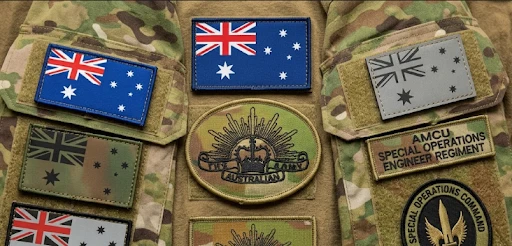
The Australian Defence Force has undergone a significant transformation in its approach to camouflage design and military uniforms over the past two decades.
With the emergence of the famous DPCU (Disruptive Pattern Camouflage Uniform) that became popular under the nickname of ‘Auscam’ to the modern AMCU (Australian Multicam Camouflage Uniform), the development of the military patches and the patterns on uniforms became evidence of both technical progress and operational need.
When seeking custom AMCU & DPCU military patches or insignia according to the Defence Force requirements, one needs to understand all the differences.
What Are Custom AMCU & DPCU Military Patches?
The emergence of the AMCU in 2014 was a significant milestone in the history of the Australian Defence Force, as this design combined the proven geometry of the MultiCam design with the unique colour palette that was tailored to the distinctive environment of Australia.
But few people know that the Australian Defence Force does not have a single unified camouflaging pattern. In fact, different divisions and specialised units of the Australian Defence Forces apply different variations of the pattern that are adjusted to the specific field of their operations.
This full guide will help you learn how to purchase authentic Australian military patches and understand the differences between AMCU and DPCU camouflages and how those patterns differ from other camouflaging patterns used abroad, for example, American OCP or UK MTP.
No matter if you are a Defence Force officer that needs to individualise his/her uniform or an organisation that needs to place orders for custom military patches in bulk, this guide is just for you.
The Evolution: From Auscam DPCU to Modern AMCU
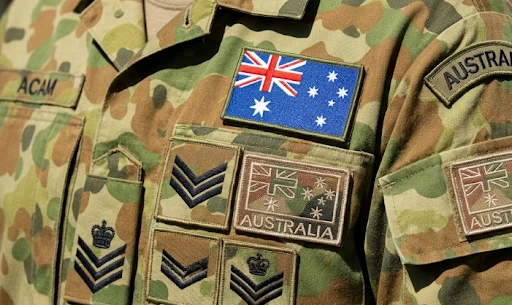
Understanding DPCU: The Original Auscam Pattern
The Disruptive Pattern Camouflage Uniform, known colloquially as Auscam, had the honour of serving the Australian Defence Force from the 1980s to 2014. At that time, the design of the pattern was considered innovative, incorporating unique shades of olive green, tan, and reddish-brown hues, which proved to be highly efficient in the conditions of the Australian bush and jungle.
Military patches stitched onto DPCU uniforms became true symbols of service in the army, easily identifiable by their unique colours, which differed greatly from those used by any other country for their military camouflages.
The design of the Auscam pattern was valued not only by Australian soldiers but also by foreign military experts. The efficiency of the pattern lay in the profound knowledge of Australian land and flora. Reddish-brown shades were carefully selected to fit the colour of the Australian outback, while olive and tan colours brought harmony in the conditions of temperate forests.
The Introduction of AMCU in 2014
The Australian MultiCam Camouflage Uniform was launched by the Australian Defence Force in 2014, which was the beginning of a new era for them. It is important to note that the AMCU was not just an adaptation of the American MultiCam uniform. It was an innovative combination of both MultiCam’s geometrical pattern and the green and earthy colours of the Auscam camouflage. The designers of the AMCU had one goal: to retain the efficiency of the MultiCam pattern while maintaining the green hues of Auscam.
The result is a camouflage pattern that shares visual similarities with the American OCP and the United Kingdom’s MTP, both of which are also derived from MultiCam. However, AMCU stands as a distinct entity, engineered specifically for Australian conditions. Military patches on AMCU uniforms maintain the professional appearance of their predecessors whilst benefiting from modernised camouflage geometry. The pattern features larger, more irregular shapes compared to traditional digital camouflage, providing superior concealment at multiple viewing distances.
Branch-Specific Camouflage Patterns: One Force, Many Patterns
A critical distinction that many people overlook is that the Australian Defence Force does not employ a single camouflage pattern across all branches and units. Whilst the shift to MultiCam-style geometries occurred during the 2010s, different branches maintain distinct pattern variations that serve both functional and identity purposes.
Royal Australian Navy: MMPU and Maritime Operations
The Royal Australian Navy operates its own specialised variation known as the MMPU, or Maritime Multicam Pattern Uniform. Rather than adopting the green tones of the AMCU, Naval personnel wear a pattern featuring muted grey, green, tan, and blue-grey tones specifically designed for maritime environments. This distinction serves practical purposes, as operations aboard naval vessels and in maritime contexts present entirely different concealment challenges compared to land-based operations.
Military patches displayed on Navy MMPU uniforms reflect this specialisation. The grey-dominated colour scheme of the MMPU creates a visual distinction that immediately identifies personnel within naval contexts. However, the Navy maintains operational flexibility. Tactical naval units, including Navy Clearance Divers, transition to the standard green AMCU when conducting land-based operations such as explosive ordnance disposal or jungle deployments. This adaptability ensures that military patches and uniforms match operational requirements.
Royal Australian Air Force: GPU and the Blue Distinction
The Royal Australian Air Force deliberately chose a distinctly different visual identity from the Army through the introduction of the GPU, or General Purpose Uniform. The Air Force’s pattern utilises MultiCam geometry but replaces the green and tan tones with sharp shades of blue, grey, and dark tones. This design choice reflects the Air Force’s primary operational context. The GPU is intended for on-base duties and domestic disaster relief operations, not battlefield concealment.
The blue and grey military patches found on Air Force GPU uniforms serve as clear visual markers of Air Force personnel. However, like their naval counterparts, the Air Force maintains operational flexibility. Air Force combat units, including Airfield Defence Guards and security squadrons, transition to standard green AMCU when deploying to tactical front-line environments. This bifurcation of patterns demonstrates sophisticated understanding of operational requirements.
Regional Force Surveillance Groups: Specialised Patrols
Australia lacks a direct equivalent to the United States Army Rangers, but the Regional Force Surveillance Groups serve analogous functions. These specialised, largely Indigenous units conduct surveillance and patrol operations across the harsh, remote wilderness of Northern and Western Australia. The RSFG personnel wear standard AMCU camouflage, a choice rooted in operational effectiveness.
The AMCU was specifically co-designed to blend effectively into Australian bush, arid dirt, and tropical environments. These are precisely the environments that RFSGs patrol and monitor. Military patches on RSFG personnel therefore display the green-toned AMCU pattern, providing both authentic camouflage and functional identity. The decision to maintain standard AMCU rather than adopt specialised variations reflects confidence in the pattern’s effectiveness for Australian terrain.
Comparing AMCU to International Standards: OCP (USA) and MTP (UK)
Understanding how AMCU compares to international camouflage standards provides valuable context for military patch design and procurement.
OCP (Operational Camouflage Pattern) and United States Operations
The United States Operational Camouflage Pattern represents the American refinement of MultiCam geometry. The OCP patches feature tan, grey, and green tones arranged in irregular geometric shapes. Whilst visually similar to AMCU, the OCP was developed through American testing and operational feedback. The pattern performs effectively in Middle Eastern and Central Asian environments, where much of American military operations have occurred.
Military patches on OCP uniforms maintain bright, sharp colours designed for visibility in daylight conditions. The United States military service branches each maintain their own patch design standards and colour requirements. When comparing military patches between AMCU and OCP uniforms, the differences reflect not only pattern design but also broader military culture and operational doctrine.
MTP (Multi-Terrain Pattern) and United Kingdom Operations
The United Kingdom’s Multi-Terrain Pattern similarly derives from MultiCam principles but incorporates adjustments based on British operational experience. The MTP patches feature a refined blend of green, brown, and tan tones. Like OCP, the MTP shares geometric similarities with AMCU but maintains distinct characteristics reflecting British military needs and environmental considerations.
British military patches on MTP uniforms adhere to specific standards regarding colour saturation and visibility. The differences between patches worn on AMCU, OCP, and MTP uniform reflect each nation’s approach to readability, identification, and operational requirements.
The Similarities and Differences
The widespread adoption of MultiCam-derived patterns by multiple nations might suggest global standardisation. However, each variant reflects specific environmental, operational, and cultural requirements. The AMCU’s particular blend of colours represents a deliberate choice to maintain effectiveness in Australian environments whilst adopting proven geometric principles. Military patches serve as physical manifestations of these design choices, making them valuable indicators of operational doctrine and environmental adaptation.
Design and Manufacturing of Custom AMCU Military Patches
The production of military patches for AMCU uniforms requires specialised knowledge and equipment that most general patch manufacturers do not possess. Bespoke AMCU patches must be sewn securely onto the AMCU’s particular fabric weave whilst maintaining visibility and durability through extended field operations. When selecting a custom military patch supplier, it is critical to partner with manufacturers who understand Defence Force specifications.
Colour Accuracy and Pattern Matching
Creating accurate custom AMCU patches requires precision colour matching that separates professional manufacturers from casual competitors. The pattern’s distinctive green and earthy tones must be reproduced faithfully to ensure patches integrate seamlessly with the uniform. Professional custom patch manufacturers utilise spectrophotometric equipment to verify that colours remain consistent across production batches. This technical precision ensures that patches maintain the same visual characteristics as the uniform fabric.
According to industry standards, colour variation tolerance for Defence Force patches is typically under 5 per cent Delta E (colour difference units). Most generic patch manufacturers operate with tolerances of 10 to 15 per cent, meaning your custom AMCU patches may appear noticeably different in shade when received. This is why choosing a specialist AMCU patch manufacturer matters significantly.
Durability and Field Performance Standards
Military patches must withstand the harsh demands of field operations. AMCU patches experience exposure to intense sun, moisture, vegetation contact, and regular washing. Quality military patches are constructed using thread that resists UV degradation and dyes that remain colourfast through extended service. Stitching must be dense and secure, preventing fraying or detachment during contact with obstacles or during medical procedures requiring patch removal.
When you order custom military patches or morale patches custom from specialist manufacturers, enquire about thread specifications, stitch count per inch, and whether the manufacturer conducts accelerated fade testing to verify colourfast performance. Patches that fail after months of field use represent a false economy.
Embroidery Versus Woven Construction for Custom Patches
Modern custom military patches employ either embroidery or woven construction. Embroidered patches provide excellent detail and precise colour control, making them ideal for small insignia and detailed designs. Custom woven patches offer advantages in terms of durability and dimensional stability. Many Australian Defence Force patches employ woven construction for operational roles, where durability supersedes fine detail.
The choice between embroidery patches and woven patches depends on your specific requirements. Small unit insignia (under 50 millimetres) often benefit from embroidery, whilst larger patches (100 millimetres to 150 millimetres) typically perform better as woven patches. When commissioning custom military patches, discuss construction options with your manufacturer to determine which approach serves your operational or institutional needs.
Acquiring Quality Military Patches for Your Collection or Requirements
Whether you are a military enthusiast, a serving member who needs his uniform customised, or an organisation that requires genuine military patches, buying high-quality military patches demands knowledge about production standards and reliable suppliers.
Working with Professional Patch Manufacturers
Military patches made by professional patch manufacturing companies are aware of the exact specifications required to be met by the Defence Force standards. The patch manufacturers will have the facilities for colour matching, quality assurance procedures, and know-how for making patches to satisfy these standards. It is important to ask these questions when choosing a manufacturer to check their experience with AMCU patterns.
Understanding Patch Specifications
Quality military patches have to meet certain specifications concerning size, colour, and fabrication techniques. You need to discuss your needs carefully with your patch provider, presenting sample pieces wherever possible. Some of the factors that should be included in the specifications include size specifications, colour specifications, stitching specifications, edge specifications, and backings ranging from quick-stick adhesive to flexible Velcro.
Sustainable and Ethical Production
Customers increasingly want military patches made from ethically made products and taking into account environmental considerations. Reputable patch makers should be able to talk about their material sourcing, labour practices, and how they manufacture their patches. Purchasing patches from makers who exhibit ethical behaviour is part of being a responsible Aussie.
Order Custom AMCU Military Patches from Australia’s Specialist Manufacturer
The progression of DPCU to AMCU is more than just an example of a pattern change, but it is also indicative of the Australian Defence Forces’ dedication to progress through technology, specificity in the environment, and superior operations. The military patch is one way that such an evolution is expressed physically.
Whether you are interested in the rich history of Auscam DPCU patches, acquiring cutting-edge custom AMCU patches, or sourcing specialist pattern alternatives comparable to international OCP and MTP standards, understanding these nuances is critical when partnering with your patch manufacturer.
Why Custom Patches Australia Stands Apart
At Custom Patches Australia, we specialise in manufacturing custom AMCU military patches that meet stringent Defence Force standards whilst respecting the heritage and significance of these designs. Our expertise in AMCU colour matching (verified to under 5 per cent colour variation), DPCU historical accuracy, and specialist pattern production ensures that your custom military patches represent excellence in both appearance and durability.
Unlike generic patch suppliers, we understand that Defence Force patches demand the following:
- Precise AMCU colour specifications verified through spectrophotometric testing
- Specialist thread materials resistant to UV degradation and field conditions
- Dense stitching standards exceeding commercial patch requirements
- Rapid production timelines without compromising quality
Frequently Asked Questions
Where can I buy custom AMCU military patches in Australia?
We offer custom AMCU military patches that adhere to Defence Force specifications. Pre-made patches are available, while custom options can be produced in various quantities. Contact Custom Patches Australia to discuss your custom AMCU patch requirements.
What is the difference between AMCU and OCP patches, and can they be used together?
AMCU and OCP patches differ fundamentally in colour profile, construction, and military standards. Mixing them violates uniform standards, causing visual inconsistency, and OCP patches do not adhere to Australian Defence Force specifications for size, material, or stitching.
How much do custom AMCU military patches cost, and what affects pricing?
Custom AMCU patch pricing varies by size, quantity, construction method, and complexity.
Can civilians purchase AMCU patches, and are there restrictions?
Civilians can buy most AMCU patches, but sensitive unit insignia are restricted to authorised personnel. Verify legal status and availability with your supplier before purchasing.
Get Ready to Order Your Custom AMCU Patches
Whether you require 10 patches for a small unit, 500 patches for organisational uniform programmes, or bespoke designs for heritage projects, Custom Patches Australia delivers authenticated military insignia that meets Defence Force standards.
Order custom AMCU & DPCU military patches today and experience the difference that specialist manufacturing delivers.
Contact our team to discuss design concepts, bulk orders, or custom project requirements.